Typhoon Nepartak helps elevate weather forecasting into an Olympic sport
Tokyo: It’s usually all about the names at the Olympics.
Bronte Campbell, Meg Harris, Emma McKeon and Cate Campbell who won Australia’s first gold medal with a world record swim in the women’s 4x100 freestyle relay team.
Fellow Aussie Ariarne Titmus, who won her gold on Monday in the women’s 400m freestyle.
Chase Kalisz. The American swimmer who won the gold medal in the men’s 400 individual.
Naomi Osaka. The list goes on.
And Nepartak. The countryless brute.
No athlete has a big enough name to stop him.
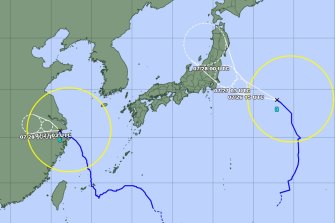
Typhoon Nepartak, right, off the coast of Japan on Monday. On the left is typhoon In-Fa which has already caused havoc in China.Credit:Japan Meteorological Agency
Nepartak, originally the name of a famous Kosrae warrior, is a tropical storm - or a typhoon in Asian nomenclature - that on day two of the Tokyo Games helped elevate weather forecasting into an Olympic sport.
If you’re betting on the Joint Typhoon Warning Centre, then Tokyo was within the dreaded forecast cone as of Sunday afternoon.
If you’re betting on Kurt Korte, official forecaster for the Olympic surfing competition, expect high waves but winds that could spoil the surf.
A woman at the International Olympic Committee news desk, when asked if the IOC had an update on Nepartak, pulled out her phone and opened a bookmarked weather forecast site.
She looked glum, too, as she pointed to the blue squares, signs of rain coming on Monday and Tuesday. Later in the day, the rowing competition set for Tuesday was cancelled.
It could be bad news for softball, too. Bad news for beach volleyball. Bad news for any sport conducted outside, because unless Nepartak veers course, the great outdoors won’t be great at all.
However, the surfers cautiously welcomed the approach of Nepartak. These are the same athletes who were hoping for a typhoon to help generate bigger waves.
“Fundamentally, in order to get surf, you have to have strong winds blowing over a big area of ocean for a long period of time,†Korte said. “If you don’t have any one of those factors, the surf can be pretty small. So this time of year, it’s obviously the northern hemisphere’s summer, we’re looking at tropical systems as our main source.â€
But for surfers, there’s a potential problem with Nepartak, along with other tropical storms, or typhoons and cyclones.
“Ideally, you want it close enough to where the swell does not decay significantly between where it’s generated and the beach,†he said, “but also far enough away where you’re not negatively impacted by the winds and conditions and the rain.â€
On Sunday, organisers said they would back any needed plans to schedule changes to competition due to heat and humidity. Then they added the typhoon was added to the list.
The women’s triathlon has been deemed ok to go ahead on Tuesday morning at Odaiba Marine Park in Tokyo Bay.
“Unlike an earthquake, we’re able to predict the path of a typhoon so we’re able to prepare in advance,†Masa Takaya, a Tokyo 2020 spokesperson, told reporters on Sunday.
“In the case of rowing, as a protective measure we have decided to change the event schedule,†he added. “We’re looking closely at the path [and] will take responsible measures.â€
Mikato Kotani, sports director for the Tokyo organising committee, said “There will be some sports that will be impacted.
“We are closely discussing with the [international federations] anything we should change.â€
Nepartak will have the final word.
USA Today, agencies, staff writers
0 Response to "Typhoon Nepartak helps elevate weather forecasting into an Olympic sport"
Post a Comment