Explaining the magic and the madness of Luke Beveridge
Gillon McLachlan had just spotted Rob Stary in the AFL offices and wondered why a noted criminal lawyer, who’d represented notorious crime figures Carl Williams and Tony Mokbel as well as terror suspects, would be in the foyer in February of 2016.
He wandered over to Stary and discovered that the lawyer, a Bulldogs tragic, was acting for one of that club’s least recognisable players, Luke Goetz, a 202-centimetre rookie ruckman from Altona who had just made what would be his sole appearance at senior level for the Dogs in a practice game at Craigieburn.
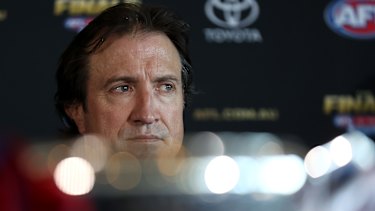
Western Bulldogs coach Luke Beveridge.Credit:Getty Images
“How many weeks did he get,†asked the AFL boss.
None, Stary replied. Goetz had been fined $1500 for pushing Melbourne’s Colin Garland over the fence, causing Garland to land on a hapless woman in the sparse terraces. Stary showed McLachlan the footage on his mobile.
Goetz looked guilty to McLachlan, who was staggered that the Bulldogs were enlisting a gun criminal lawyer to fight a case on behalf of an obscure player, who’d not even been suspended, in pre-season.
Somewhat perplexed, he asked Stary why they were taking this case to the tribunal.
“The coach wants to fight this,†Stary explained.
“And that’s when I knew Beveridge would be a good coach,†McLachlan told The Age on Thursday, two days before the mercurial Bulldogs coach seeks to upend the Demons and coax the Dogs to a second improbable, backs-to-the-wall premiership within five years.
What McLachlan discerned was that Beveridge would fight for his player, in what many of us would view as a hopeless cause, in a low-stakes case. Backing the player overrode all other considerations - a leitmotif of Beveridge’s coaching career, from St Bede’s in the Victorian amateurs to Collingwood (development coach), Hawthorn (assistant and architect of team defence) to the Bulldogs.
Remembering the incident, Easton Wood, who would captain the Bulldogs to that fabled flag later that year, observed that “Bevo†would have understood that for a rookie-list player like Goetz, a $1500 fine would really hurt.
“Bevo’s always been a great advocate for defending us,†said Wood. A difference between Beveridge and some other successful coaches, perhaps, is that the Bulldogs man will wade into battle on behalf of all creatures, great and small - be it Marcus Bontempelli and Tom Liberatore or Luke Goetz - and not simply the Alpha players.
This willingness to go over the top in defence of the player was graphically repeated in Beveridge’s counter-attack on behalf of Adam Treloar following the preliminary final. The coach unloaded on the media, calling critiques of Treloar’s performances “vindictive†while savaging the unnamed critics. “I don’t know how people can live with that, how they can lie in bed with that, how they can look themselves in the mirror.â€
Football people familiar with Beveridge method in his madness could see that the coach wouldn’t care what the media - or public - made of his comments, which seemed excessive and unwarranted. The external audience wasn’t the intended target.
He was speaking to Treloar, just as Damien Hardwick was communicating to Tom Lynch when he labelled media commentator and ex-Demon David Schwarz cowardly (ridiculing Schwarz for “crying†in the 2000 grand final) last year.
Beveridge, from the testimony of club and competition insiders, is best understood as a combative tribal chieftain, who will go to extreme lengths to defend his own and take up the cudgels if he believes the player/club/himself have been unjustly wronged.
“If Luke has a super power, it’s that he’s impervious to embarrassment.â€
Bob MurphyIt was Beveridge who relentlessly drove the Bulldogs to push for an investigation into the alleged leaking of his team’s plans for Adelaide in the 2015 elimination final (that the Dogs narrowly lost), via Bulldog Michael Talia to his brother Daniel at the Crows.
Beveridge phoned Crow Kyle Cheney, whom he’d coached when an assistant at Hawthorn, and another Hawk, to buttress a case that he - and other Bulldog officials - were convinced was right, but the AFL found insufficient to lay any charges.
Beveridge wasn’t embarrassed by the Talia investigation outcome, any more than he’s embarrassed by crying in front of others or enlisting a criminal lawyer to fight the fining of a guilty fringe player in a meaningless practice game, because, according to various witnesses of his leadership style, he doesn’t do embarrassment. He once said he could be brought to tears watching cartoons.
“If Luke has a super power, it’s that he’s impervious to embarrassment,†said Bob Murphy, the storied former skipper of the Bulldogs, who felt Beveridge had “hypnotised†the playing group in 2015 and 2016. “I still may be hypnotised from 2015.
“All the good ones (coaches) are mad,†Murphy added. “It’s just a matter of which type.â€
In the telling of both Murphy and Wood, who deputised for the injured Murphy on grand final day 2016, there was a moment in 2015 when they became, if not entranced, then believers in Beveridge as the coach-of-destiny.
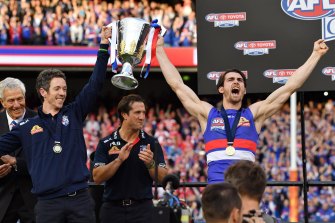
The premiership dais in 2016.Credit:Joe Armao
The Dogs had just upset the Swans at the SCG by two points in a stirring victory. The players had sung the song with euphoric gusto. They went into the team meeting, where Beveridge was, “pacing back and forth and he’s silentâ€.
This silence lasted for minutes. What would he say after that special win? Wood looked at the coach. “You could see tears in his eyes.â€
Murphy recalled Beveridge uttered just one sentence. “I’m proud of you.â€
Wood said of the SCG game aftermath: “I can’t overstate what that moment solidified.†Murphy’s take: “I think he had the players for life after that moment.â€
Wood says that Beveridge gave the players emotionally safe space, instead of asking them to conform to a football prototype of hardness. “He gave us permission to be who we are,†explained Wood. This philosophy was more formally adopted by Richmond in 2017, in their vulnerability sessions, and became de rigeur within clubs.
Wood did not say so, but the sense from club people from that time is that Beveridge’s predecessor, Brendan McCartney, had demanded flint-hardness and was less accommodating of individual foibles.
The best coaches such as Alastair Clarkson and Beveridge are usually obsessive, controlling and, above all, horse whisperers who convince the players to believe in each other. “That’s the art of coaching,†said Murphy. “Convincing the players that they’re more than they are.â€
But Beveridge is also not a coach to be crossed or let down badly, as Michael Talia and Jake Stringer discovered, and he’s willing to send a player to Coventry, as the English say, in the interests of the whole organisation. There was no Stevie Johnson second chance for Stringer when he was discarded in 2017, at Beveridge’s insistence, for the sake of the club’s culture.
“If you get on the wrong side of him, good luck coming back,†said Matt Beasley, who was president of St Bede’s-Mentone when Beveridge pulled off the unfathomable feat of coaching the club to flags in C, B then A grade in the VAFA in consecutive seasons from 2006 to 2008.
Beasley, a fellow St Bede’s schoolboy who remains friends with Beveridge, a Bentleigh boy with deep roots in the south-eastern football community. He knows Beveridge’s parents and the coach’s eclectic interests - such as surfing and (once) skateboarding, as he would en route to training at St Bede’s.
Luke’s father John was the respected head recruiter at St Kilda for decades from the days of zones into the 2000s, while his mother Rosa has Greek heritage, which enabled Luke to be named in the Greek team of the century. The parents separated long ago. His grandfather Jack Beveridge was a significant member of the Collingwood “machine†that won four flags from 1927-30 and later went on to coach in Launceston and Horsham.
Beveridge, one could argue, is the very template for a successful coach: a battling player, who eked out 118 games at three clubs - Melbourne, the Bulldogs and St Kilda (he remains in touch with Melbourne’s past players) - and then coached a local club with outrageous results before moving up the AFL coaching foodchain.
“He studied fashion as an additional subject when he was getting a business degree,†said Beasley. Beveridge famously left Collingwood after the 2010 premiership to return to a senior job at AUSTRAC, the government agency that follows the flow of laundered criminal money, before joining Clarkson at the Hawks, where he was not afraid to put forward his views contrary to the no less pugnacious “Clarko.â€
“He’s got no fear,†said Beasley, who marvelled at the younger Luke’s ability to be out until 2am and then ride his bike to work.
His audacity has been evident in Beveridge’s willingness to make experimental positional changes, such as shifting Josh Schache to defence for the last encounter with the Demons after scant games in that role in the twos, in what became preparation for Schache’s surprising success in the finals as a defensive or “occupying†forward.
In 2015, Beveridge deployed half-backs Jason Johannisen and Murphy playing up as extras at the stoppages. Over time, the rival clubs countered by loading up their forward line and out-numbering the Dogs, six on five - a set-up that few coaches would tolerate (mostly they protect their defenders with numbers).
Beveridge, however, took an unconventional view. “Our five (backs) will be fine against their six,†was how Murphy’s recollected the coach’s rationale, which had the out-numbered likes of Wood “playing out of their skin†in defence.
“He’s brave enough to be winning because he doesn’t get embarrassed.″â£
He coaxed the Dogs to a flag from seventh, and would have them win another from the clouds this year, albeit with exceptional talent. They’ve traversed the continent, been barred from training at Adelaide Oval (not counting the final v Port), while their combative coach pits himself against the South Australian health authorities and Treloar’s supposed detractors.
He’s faced far worse odds than Saturday’s grand final. In 2008, when St Bede made the grand final for the A-grade flag, they’d met what Beasley said was a superior Collegians side, who’d beaten Bevo’s boys by close to 100 points only a few weeks earlier. “That didn’t faze him,†said Beasley, as St Bede’s pulled off, in amateur terms, something akin to the Dogs’ flag of 2016.
“Finishing fifth was an absolute gift,†said Murphy, who said all Beveridge’s travails on the road were made to order for him. He’s the consummate underdog, us-versus-the world coach.
Murphy and Beasley still find parts of Beveridge unknowable. The latter reckoned he was the smartest person he knew. “I’m still trying to work him out.†Murphy reckoned Beveridge was emotional but not erratic. “He’s zen without being a wimp.″â£
Whether this pugnacious, emotional yet calm, bold but calculating tribal chieftain can lift his team to the pinnacle again, against expectation, or if he fails, we can count on this: That Luke Beveridge won’t be embarrassed.
Keep up to date with the best AFL coverage in the country. Sign up for the Real Footy newsletter.
Jake Niall is a Walkley award-winning sports journalist and chief AFL writer for The Age.Connect via Twitter or email.
0 Response to "Explaining the magic and the madness of Luke Beveridge"
Post a Comment